President Barzani: We Participated in the Elections to Show the True Strength of the Kurdistan Democratic Party to Other Forces
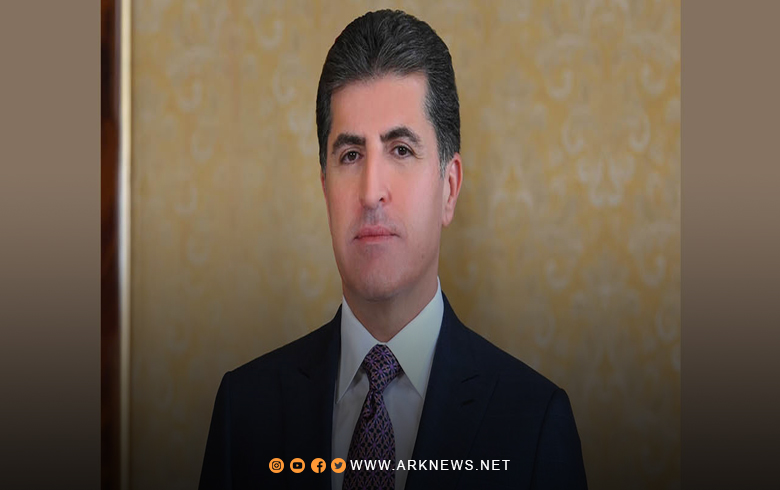
ARK News.. President Masoud Barzani said on Friday evening, November 7, 2025, during a massive rally in support of the Kurdistan Democratic Party (KDP) list No. 275 at the Franso Hariri Stadium in Erbil, that the KDP decided to take part in the upcoming Iraqi parliamentary elections despite knowing that the results would not significantly change the number of its seats, emphasizing that the decision was made for two fundamental reasons.
“We are well aware that these elections may not increase our seats,” President Barzani stated, “but we received many messages from our friends confirming that participation is necessary to achieve meaningful reforms through the next parliament.”
“The second reason,” he continued, “is to demonstrate to other parties the true strength of the Kurdistan Democratic Party and the depth of its popular base. Boycotting or distancing ourselves from the process would not serve our cause or the interests of the Kurdish people.”
President Barzani reiterated that Iraq’s current election law was drafted to serve the interests of certain sides and must therefore be amended.
He explained that the KDP has a clear vision and knows exactly what it wants to achieve. “If this election allows us to work with our friends and partners to find a solution to the current situation and restore the political process to its proper course, that will form the core of our program for the future,” he said.
Barzani stressed that the first step should be to amend the electoral law and return to a single-constituency system based on party or semi-open lists, noting that the current law is unfair and wastes the rights of many parties. “It was tailored to satisfy certain actors, and therefore, it must be changed,” he said.
“It is unacceptable,” he added, “that winning one seat in Erbil requires around 40,000 votes with a 70–80% turnout, while in some southern provinces the same seat is decided with only 2,000 votes and a turnout of less than 20%.”
Regarding the formation of the new Kurdistan Regional Government (KRG) cabinet between the KDP and the Patriotic Union of Kurdistan (PUK), President Barzani said that after the Kurdistan parliamentary elections, the KDP invited all political forces to join a broad-based government, but most chose to remain in opposition — a decision the party respects.
He noted that the two high committees of the KDP and PUK later began talks focused on two main issues: the system of governance and the distribution of positions. “We reached an agreement on the first point,” Barzani said, “and the KDP showed flexibility on the second. However, the PUK tried to delay decisions until after the federal elections in Iraq — a position that cannot continue afterward.”
President Barzani also revealed plans to work toward the establishment of the Federation Council in Baghdad, which he said would serve as a constitutional safeguard for the rights of the Kurdistan Region and other provinces.
He called for taxation and customs laws to be legislated in accordance with the Iraqi Constitution and reaffirmed that Article 140 “cannot be forgotten or abandoned. He added: “To our brothers and sisters in the disputed areas, rest assured — you are always in our hearts.”
Barzani also underscored the need to pass the oil and gas law in line with the Constitution to remove any pretexts used by certain parties in Baghdad to create tensions.
He further stated that the federal government is obligated to compensate the victims of the Anfal campaigns, chemical attacks, and other war-affected areas, emphasizing that this duty must be fully carried out.
President Barzani reiterated that Iraq’s stability depends on returning to the three foundational principles agreed upon in the 2002 London Conference before the fall of the previous regime — partnership, balance, and consensus.
“These three principles,” he said, “form the spirit of the Iraqi Constitution. If Iraq returns to them, no problems will persist — not between Erbil and Baghdad, nor among other provinces.”
He emphasized that full adherence to the Constitution and these three principles would protect Iraq from authoritarianism and guarantee a stable life for all its citizens.
“If these principles are upheld,” he concluded, “no one will again be able to arbitrarily withhold the Kurdistan Region’s salaries and budget. Such actions are not only a grave injustice but also a deep insult to the blood of our martyrs — and must never be repeated.”
485