Greece: Lead Poisoning Concerns in New Migrant Camp
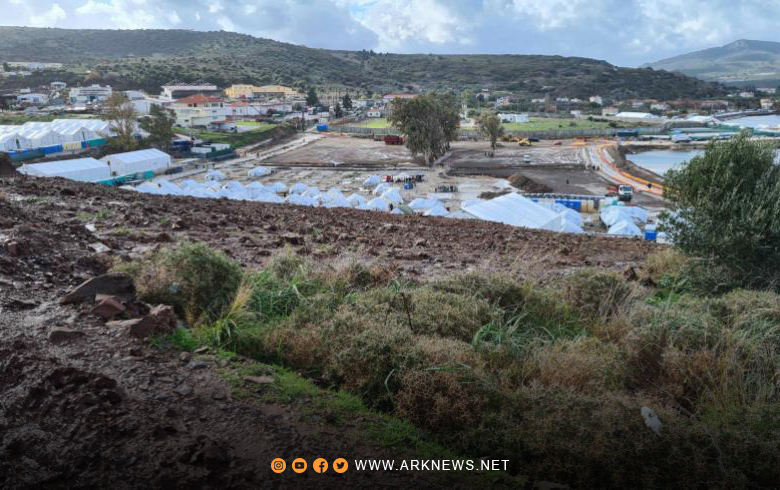
Thousands of asylum seekers, aid workers, United Nations, and Greek and European Union employees may be at risk of lead poisoning in a new migrant camp that Greek authorities have built on a repurposed military firing range on the island of Lesbos, Human Rights Watch said yesterday.
Firing ranges are commonly contaminated with lead from munitions, nevertheless, the authorities did not conduct comprehensive lead testing or soil remediation before moving migrants to the site in September 2020. Evidence collected by migrants moved to the site also indicated that authorities have also failed to clear all unexploded mortar projectiles and live small arms ammunition, which could injure or kill if disturbed or handled.
“Putting thousands of migrant adults and children, along with aid workers, on top of a former firing range without taking the necessary steps to guarantee they would not be exposed to toxic lead is unconscionable,” said Belkis Wille, senior crisis and conflict researcher at Human Rights Watch. “The Greek authorities should promptly conduct a comprehensive site assessment of soil lead levels and release the results.”
In November and early December, Human Rights Watch interviewed four people living in the camp, two aid workers, one Greek migration ministry employee working in the camp, and four medical and environmental experts, and reviewed academic research on the risk of soil lead contamination at shooting ranges and medical research on the health risks of lead poisoning. Human Rights Watch did not have access to conduct on-site research but analyzed photos and videos of the site and satellite imagery to confirm the firing range location.
The Asylum and Migration Ministry began major construction work at the end of November at the site, called Mavrovouni camp, that could disturb any lead-contaminated soil, further exposing residents and workers. The work to improve access to electricity and water and reduce the risk of flooding began despite warnings from Human Rights Watch of the potential of increased risk of lead poisoning.
Firing ranges are well-recognized as sites with lead contamination because of bullets, shots, and casings that contain lead and end up in the ground. Lead in the soil from bullet residue can readily become airborne, especially under dry and windy conditions, which often exist on Lesbos. Lead is a heavy metal that is highly toxic to humans when ingested or inhaled, particularly by children and during pregnancy. It degrades very slowly, so sites can remain dangerous for decades.
Small children and women of reproductive age are at particular risk. According to Greek authorities, on November 19, 2,552 out of 7,517 people in the camp were children, 997 of them under age 5, and 1,668 were women – 118 of whom have said they are five or more months pregnant.
Camp residents shared 17 photographs of items they said they had found in the ground around their tents, including an intact 60mm mortar projectile and a tail fin assembly for another 60mm mortar projectile, cartridge casings for rifle bullets, fired 12-gauge shotgun cartridges, and live pistol, rifle, machine gun, and shotgun ammunition. Intact munitions, such as 60mm mortar projectiles and small arms ammunition, pose an immediate explosive hazard and should be removed urgently from the area.
“We try to stop our children from going to play up the hill because we know there might be bullets and other things the army didn’t clear that could be dangerous,” one camp resident said. Munitions containing lead can be extremely dangerous when swallowed by children or contaminate the soil, a medical expert told Human Rights Watch.
The authorities should conduct a thorough and transparent assessment of lead levels in the soil and dust, as well as other possible pathways to exposure, and make the results publicly available. Any work that might increase exposure should be paused until after the soil has been tested or until people have been removed from the camp and housed inadequate facilities, Human Rights Watch said. If lead is present in the soil, authorities should provide free blood testing and treatment for camp residents, aid workers, police, and others who might have been exposed, prioritizing young children and women of reproductive age, and immediately move exposed residents to a safe location and remediate the contaminated areas.
“The Greek government could be putting at-risk families with young children, aid workers, and its own employees because it’s determined to hold asylum seekers on the island,” Wille said. “If this is where the government is trying to force asylum seekers to live on Lesbos, then all the more reason to transfer people to the mainland.”
The Mavrovouni site sits on a large plot of military-owned land, some of which was used as a military firing range since 1926. The Asylum and Migration Ministry said that it covered the site with “new levels of soil” before the camp was opened.
Human Rights Watch reviewed satellite imagery from before and after construction began on the camp on September 11, 2020. Imagery from before shows a firing range on part of the site next to Mavrovouni Hill. By September 28, more than 200 tents had been set up directly on the former firing range itself, with more tents on adjacent areas.
Satellite imagery from June, before Moria camp was destroyed by fire, shows some basic clearance of vegetation cover within a rectangular strip that included the firing range, as well as a small section at the base of Mavrovouni Hill. From the imagery, it is impossible to determine the depth of the soil removal and whether the remediation of lead impacted soil was completed in accordance with prevailing standards and guidelines, or if it was just a superficial scraping of topsoil.
Human Rights Watch was unable to determine what soil removal activities took place between June and September, when the camp opened, or of other activities to decontaminate the ground or where soil removed was disposed of. Given the speed of camp construction, it is very unlikely that authorities could have carried out remediation of lead-impacted soil before setting up the tents. Greek authorities have indicated that new soil was placed prior to construction of the camp, with no location indicated.
Satellite imagery analysis, combined with a review of photos and videos of the firing range that were posted online in the spring, shows that the military was shooting from the southwest toward targets in the northeast, at the foot of Mavrovouni Hill. This suggests that soil on the hillside might also be contaminated by lead.
Imagery recorded between September 14 and 16, shows at least 300 tents just south of the hill without any prior signs of soil clearance, with another at least 170 added in the following days. Imagery from late November shows further ground preparation southeast of the hill and the construction of four large structures.
Medical and environmental experts interviewed said it was risky to conduct further work in the camp without first conducting soil samples. “Disturbing this area will mobilize the lead in the soil and make it more vulnerable to dispersion from periodic rainfall, flooding, and wind erosion,” said Jack Caravans, professor of global environmental health at New York University. Dr. Caravanos has visited and assessed dozens of lead-contaminated sites throughout the world and expressed dismay over how this site was chosen without proper environmental investigation.
A European Commission official who is involved in migration policy with Greece said that the Greek Defense Ministry claimed that “no pieces of lead were observed on the ground” during construction or other work. Because lead dust is usually not visible, this claim raises concerns about the seriousness of the Greek government’s assessment.
A source close to the police said that the government had considered turning the firing range into a campsite as early as 2015. At the time, authorities rejected the proposal for several reasons, the source said, including because it had been a firing range. It is unclear why the government ignored these concerns in 2020. A migration ministry employee working on the camp who spoke on the condition of anonymity said that in SepGreece: Lead Poisoning Concerns in New Migrant Camp
tember, before Mavrovouni was selected, the government met with a few larger nongovernmental organizations and discussed at least two or three alternative locations.
In his letter to Human Rights Watch, Minister Mitarachi said that the range had only been used for “small arms (straight trajectory), commonly only bullets, and not for other types of ammunition.” This ammunition, he said, “according to the Greek Army, contains no lead.” He added that the army had searched the camp for munitions prior to opening, and again 20 days later, and “reported no findings.”
In contrast to these claims, bullets used for rifles, pistols, and machine guns as well as Greece: Lead Poisoning Concerns in New Migrant Camp
hot used by shotguns usually contain lead, which is used in bullets for its density and penetrating ability. Research at firing ranges has found that the discharge of lead dust from shooting results in soil contamination. Research has shown that elevated blood lead levels are commonly found in users of these sites, even among those who use them for limited amounts of time for recreational purposes.
The large amount of fired small arms casings and cartridges found at the camp indicates an equally large number of bullets and shots might be buried beneath the ground where they landed. Other areas near the firing range may have been affected, including from relocation of soil associated with the construction of the camp or historic clearing of soils and munitions from the firing range. Thus, it is likely that any soil contamination extends beyond the firing range. Greek authorities provided no documentation for their claim that all the munitions used at the firing range were lead-free. This claim is highly questionable, given that lead-free bullets are expensive and very rare, particularly prior to the 1980s. Some bullets have an external metal-alloy coating that may make them appear to be lead-free, but the coating disintegrates relatively quickly when the bullet enters the soil, and the lead core becomes exposed. In addition, the photographic evidence from camp residents does not appear to support this contention.
Camp residents shared with Human Rights Watch five photographs, one dated September 20, and two videos of the Hellenic Army's Land Mine Clearance Squad carrying out clearance activities without any protective equipment and disregarding distancing between them and camp residents needed for safe ammunition clearance activities.
The migration ministry employee working in the camp who spoke on the condition of anonymity said she remembered clearance operations taking place around that date: “There were soldiers who had this machine to detect metal walking amongst us. They were so close that we had to pick up our feet from the ground so they could check right under us.” A government employee’s union made a formal complaint about general working conditions at the camp, including their concerns around these clearance activities.
In addition to camp residents, anyone working inside the camp could also face potential lead exposure from spending time in the camp if the soil is contaminated. Residents, aid workers, and the migration ministry employee said that these include staff from the Hellenic Police, Hellenic army, municipality, First Reception Service, Asylum Service, National Public Health Organization (EODY), European Commission, European Asylum Support Office (EASO), European Border and Coast Guard Agency (Frontex), Europol, IOM, UNHCR, UNICEF, World Health Organization, Red Cross, and at least eight other medical and aid groups.
Symptoms of lead poisoning are often not diagnosed as such but its adverse health effects can be irreversible. The severity of symptoms increases with prolonged exposure. Globally, lead exposure is estimated to account for up to one million deaths annually, with the highest-burden in low- and middle-income countries. Poor and disadvantaged populations are more vulnerable because undernourishment increases the amount of ingested lead the body absorbs.
Children are especially at risk because they absorb four to five times as much lead as adults, and their brains and bodies are still developing. In addition, small children often put their hands in their mouths or play on the ground, which increases their likelihood of ingesting or inhaling lead in dust and dirt. Exposure during pregnancy can result in stillbirth, miscarriage, and low birth weight, and can negatively affect fetal brain development. At least 118 pregnant women and 2,552 children are at the site, according to government data.
Mohammed Hafida, a camp resident with three young children whose wife is pregnant, said that when they first moved to the camp it was particularly dusty. “When cars drove past the tents there was dust everywhere,” he said. “That only went away once the rain set in two weeks later. But the camp is on a hill, and so when it rained for several hours, many of the tents collapsed. This isn’t a camp, it’s a hell.”
People living in the camp said that for the first few weeks, they had been sleeping on blankets and mattresses on the dusty ground, but more recently aid workers had added flooring to the tents. Even as rainfall increased, residents reported that dust would still enter the tents including in the cooking areas. Camp residents said they have to clean dust out of their tents multiple times a day because cars are driving on adjacent gravel roads. Children often play in the dusty area by the roads. A medical expert said that small children at the camp are at very serious risk for as long as they are exposed to dust that could be contaminated.
Camp authorities did not inform residents that there could be a risk of lead exposure at the site. Medical and environmental experts said that given the known risks of lead exposure at firing ranges, comprehensive soil testing should have been carried out before even considering it as a possible location for the camp. They warned of specific risks of lead poisoning for small children who are most at risk. “Remediation can be very difficult,” said Caravanos, the NYU professor of global environmental health. “I can’t imagine that you could make it safe without removing everyone if the lead was found in the soil.”
On November 17, Human Rights Watch was notified about significant planned construction work, which the Asylum and Migration Ministry confirmed in a letter dated November 19. On November 26, Human Rights Watch sent a letter with detailed findings to the Greek Ministries of Asylum and Migration and Defense, which is also shared with EU officials and representatives from UNHCR, the United Nations refugee agency, and the World Health Organization, saying that these actions risk further exposing residents and construction workers to any potentially lead-contaminated dust and soil. Despite these warnings, on November 30, residents of the camp informed researchers that large construction was underway, including on top of Mavrovouni hill.
The authorities should have been aware of the amount of dust construction causes at the site. During the construction of the camp in September, the migration ministry employee said, workers had been moving around lots of soil to make room for the camp structure and “There was a lot of dust everywhere for days. I kept finding dust and even little pebbles in my ears at that time.”
Three people interviewed in November said that the authorities forced them to move to the camp after the fires in Moria camp by threatening that the government would stop their asylum claims if they refused. All three have found and provided Human Rights Watch with photographs of munition remnants since moving to Mavrovouni in September. They all said that after moving to the site, they saw the Greek military conduct clearance operations without protective gear, and they shared videos of those operations with Human Rights Watch.
Two medical staff from a team providing health care in Mavrovouni camp said on November 10 that, since arriving at the camp in October, they had not heard anything about possible lead exposure. Both said that the camp had “decent” health care services considering that it was a temporary camp, but that the laboratory inside the camp does not have the capacity to perform blood tests for lead levels. Both said that because of the nature of the symptoms of lead poisoning, which are also symptoms of other illnesses, it would be extremely difficult to diagnose potential cases without blood tests.
Both medical staff and a doctor who had worked previously at the camp said it was very difficult for camp residents to visit the hospital due to movement restrictions related to Covid-19.
Members of the Greek parliament should pay attention to the concerns that there may be lead contamination at the Mavrovouni camp and assess the Greek government’s compliance with its obligations under national, European, and international law to realize the rights to a healthy and healthy environment. They could hold a hearing or establish an inquiry to establish which government employees were involved in approving the site, the extent to which they knew or should have known about the risk of lead contamination, why they decided to move people to the site without first conducting comprehensive soil testing, and why, despite multiple concerns about lead contamination raised after the camp was opened, the authorities green-lighted construction work without first conducting comprehensive soil testing. They should take appropriate action to ensure accountability if merited.
The European Commission, which financially supports Greece to manage the camp and has staff stationed there, as well as EU agencies, Frontex, and EASO, should urge Greek authorities to comprehensively test for lead and make the testing plan and results public.
Human Rights Watch and other nongovernmental groups have long warned European leaders about the dire conditions in island camps, also known as hotspots. These have been exacerbated by Greek authorities’ containment policy, which has blocked transfers to the mainland. For years, residents were crammed into overcrowded, inadequate tents, with limited access to food, water, sanitation, and health care, including during the pandemic and despite the risk of Covid-19. The EU and Greece should fundamentally reconsider their hotspot approach on the Greek Islands and end policies that lead to the containment of thousands of migrants and asylum seekers in us Greece: Lead Poisoning Concerns in New Migrant Camp
table, and in this case potentially hazardous, facilities.
472