Sinjar: When “Liberating the Kurds” Becomes a Project to Hand Them Over to Someone Else
By Nawroz Barfini
There are political questions that require neither investigative committees nor strategic experts nor even theorists of great revolutions. All that is needed is to put the facts on the table and allow common sense to do the rest.
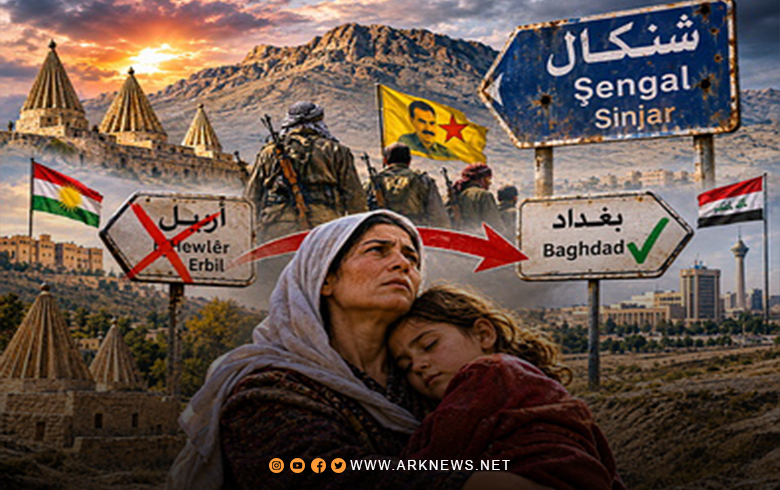
One of the strangest questions today is this: How can a party that raises the banner of defending the Kurds refuse to hand Sinjar over to the Kurdistan Regional Government, yet have no objection to the area ultimately coming under Baghdad’s authority?
This is where the dark comedy begins.
If the principle is “Sinjar belongs to the Kurds,” the obvious questions are: Which Kurds? Whose Kurdish will? And who has the right to decide the fate of a land whose population is predominantly Kurdish Yezidi and whose people should have the first and foremost say?
But when the position becomes, “We will not hand it over to Erbil, but we can hand it over to Baghdad,” this is not a new political theory. It requires an entirely different dictionary to define it!
A contradiction that needs explaining
For many years, we were told that the Kurdistan Workers’ Party (PKK) had a revolutionary project that transcended borders, that it fought for the freedom and rights of peoples, and that it rejected the domination of states and regimes.
Yet in Sinjar, the picture appears far more perplexing.
The agreement signed by Baghdad and Erbil in 2020 under UN auspices set out a clear framework for security and administrative arrangements in Sinjar. It stipulated the withdrawal of other armed formations and the termination of the presence of the PKK and its affiliated organizations in the area.
Nevertheless, nearly six years later, Sinjar still appears to be waiting for a decision-maker who has yet to arrive.
What is particularly controversial is that the rhetoric rejecting any role for Erbil in determining Sinjar’s future appears willing to accept Baghdad having the final say.
This raises a legitimate question, albeit with a touch of sarcasm:
Is the problem that Sinjar comes under the authority of the state, or is the problem simply that this state is Kurdish?
From “rejecting states” to “welcome, Iraqi army”!
Here the contradiction reaches its peak.
A movement that built part of its historical discourse around rejecting national borders and nation-states has ultimately found itself facing an extraordinarily simple formula:
No to Erbil…
Yes to Baghdad!
What a great revolution!
It has taken decades of speeches, slogans, and political theories to arrive at this supposedly brilliant equation: if the decision comes from Erbil, it is a “conspiracy”; if it comes from Baghdad, it is a “national arrangement”!
This is not a criticism of the Iraqi army or the Iraqi state. Iraq is an established sovereign state, and it has the right to exercise its sovereignty over its territory.
But the legitimate political question is:
Why is Baghdad’s sovereignty acceptable when it serves as an alternative to Erbil’s role?
This is the point that no serious discussion about Sinjar should evade.
The disaster is not Baghdad alone… It is the mentality.
The real problem is not that Sinjar is part of Iraq.
Geographically and politically, Sinjar is Iraqi. Its people are Iraqi, and the Yezidis have their own cause, rights, and distinct identity, all of which must be respected.
The problem is allowing Sinjar to become a bargaining chip in a conflict between Kurdish, regional, and Iraqi forces, rather than putting the interests of its people first.
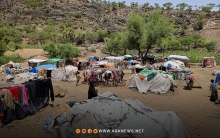
The Yezidis, who suffered some of the most horrific crimes at the hands of ISIS, do not need further political guardianship.
They need:
- Security.
- Stable administration.
- Reconstruction.
- The return of displaced people.
- Protection of their identity and distinctiveness.
- An end to the existence of multiple authorities and armed groups.
This is precisely why the continuation of the armed situation in Sinjar poses a danger to its people before it becomes a political problem for either Erbil or Baghdad.
Another irony is that “guardianship” has apparently become a revolution!
The most troubling question is this:
Does any party, regardless of its name or slogans, have the right to decide the future of an area simply because it entered it at some stage of the war?
If the answer is yes, what remains of the will of the local population?
And if the answer is no, why should the wishes of Sinjar’s own people not take priority?
Turning Sinjar into a “sphere of influence” for any party, state, or armed force is an injustice to its people.
Even more dangerous is the possibility that the Yezidis will become merely a label used by political forces to justify their presence.
One day in the name of protecting the Yezidis.
Another in the name of liberating them.
Another in the name of defending them.
And yet another in the name of representing them.
Every time, the Yezidis themselves are the last people asked for their opinion!
At this point, sarcasm seems unavoidable: it appears that everyone has discovered that the Yezidis need someone to represent them—except the Yazidis themselves!
What has this approach done to the Kurdish cause?
Here we arrive at the bigger question:
Does this approach serve the Kurdish cause?
In my assessment, the opposite is true.
The Kurdish cause cannot become a project that divides Kurds into rival camps. Nor can it turn into “Erbil against Qandil,” “the Kurds of Iraq against the Kurds of Turkey,” or simply “Kurds against Kurds,” while the real beneficiaries of this conflict are those who oppose the Kurdish cause.
When a Kurdish party becomes more confrontational towards the Kurdistan Regional Government than towards the forces threatening Kurdish rights, a legitimate question arises:
Who ultimately benefits from this conflict?
When Baghdad becomes an acceptable alternative to Erbil, and Sinjar turns into an arena of competition among different forces, the Kurds are not the primary beneficiaries.
Those who seek to weaken the Kurdish community from within stand to benefit.
Sinjar is not the spoils of war.
This must be stated clearly:
Sinjar is not the spoils of war for the PKK. It does not belong to the Kurdistan Regional Government, Baghdad, or any regional state. Nor is it a bargaining chip in the hands of any regional power.
Sinjar belongs to its people.
Its security must serve its people.
Its administration must operate in accordance with Iraqi law and the constitution, while safeguarding the rights and distinctiveness of its residents.
Turning it into a military base, a sphere of influence, or a bargaining chip means prolonging the tragedy.
More dangerously, the continuation of the current situation could open the door to further regional and international intervention, because a security vacuum and the presence of multiple armed forces do not remain a local problem forever.
History has shown that an area turned into an arena of conflict among multiple forces does not remain in the hands of its people for long.
Here, I have a message for the Kurdistan Workers’ Party: If you want to protect the Kurds, do not besiege them!
When you claim to defend the Kurds, yet engage in a conflict with an elected Kurdish institution, refuse to hand an area over to a Kurdish force, while accepting that it may come under the authority of a non-Kurdish force, you should expect people to ask:
Where is the Kurdish project in all of this?
And if your answer is that “Erbil does not represent the Kurdish cause,” the next question is:
Who gave you the right to represent it?
The Kurdish cause is greater than any party.
Greater than any leader.
Greater than any organization.
Greater than any mountain, city, or sphere of influence.
One of the most serious political mistakes is for a party to believe that it embodies the cause itself, and that anyone who opposes it is opposing the Kurds.
The Kurds are not a single party, and the Kurdish cause is not the private property of any organization.
What is needed is not an Erbil victory over Qandil, or a Baghdad victory over Erbil.
What is needed is for Sinjar to prevail over chaos.
For the Yazidis to overcome fear.
For displaced people to return to their homes.
For uncontrolled and unauthorized armed presence to disappear.
For local administration to become capable of functioning.
And for borders, sovereignty, and the rule of law to be clearly defined.
This requires an understanding between Baghdad and Erbil, not a political war between them.
It also requires respect for the will of Sinjar’s people, rather than using them as fuel for the conflicts of others.
The Sinjar Agreement itself was based on coordination between the federal government and the Kurdistan Regional Government. It set out security and administrative arrangements aimed at restoring normal life and stability to the area.
The solution, therefore, is neither to exclude Erbil nor to exclude Baghdad. It is to establish a clear legal framework that safeguards the rights of Sinjar’s residents and prevents any armed organization from turning the area into a permanent sphere of influence.
The irony worth recording in golden ink is that a party that once declared that it had come to break borders and traditional national frameworks may ultimately end up entrenching a reality that brings Sinjar closer to Baghdad and further away from any form of Kurdish coordination.
If this is what “victory” means, perhaps the political dictionary needs an urgent revision of the word!
A party that tells the Kurds:
“I will not leave you under Kurdish authority, but I will accept you coming under another authority."
cannot expect people to applaud it as the guardian of the Kurdish project.
The Sinjar issue is not the PKK’s issue alone.
Nor is it Baghdad’s issue alone.
It is the cause of a people who have endured genocide, displacement, and destruction, and who deserve to live in dignity and security.
For this reason, continuing to turn Sinjar into a zone of military and political influence will deepen Kurdish divisions, widen the rifts among Kurdish forces, and could open the door to further regional and international intervention.
The most dangerous outcome would be for conflict among the Kurds themselves to become the main story, while the fundamental issue disappears behind it.
The Kurdish cause does not need anyone to monopolize it.
It does not need a party to decide unilaterally who is a “true Kurd.”
And it does not need more guns.
It needs political unity, institutions, the rule of law, democracy and respect for the will of the people.
In Sinjar in particular, above all else, its people must be asked:
What do you want?
If the answer is security, peace, return, reconstruction and a dignified life, then everyone must take a step back.
But if every side insists on saying:
“Sinjar is mine… but not for Erbil!”
Then perhaps it is time to ask the most bitterly ironic question of all:
If Sinjar belongs neither to the Kurds nor to the people of Sinjar, then whom is this entire battle being fought for?
المقال يعبر عن رأي الكاتب
48