The Life Journey of the Leader and Spiritual Father of the Kurdish Nation, Mullah Mustafa Barzani
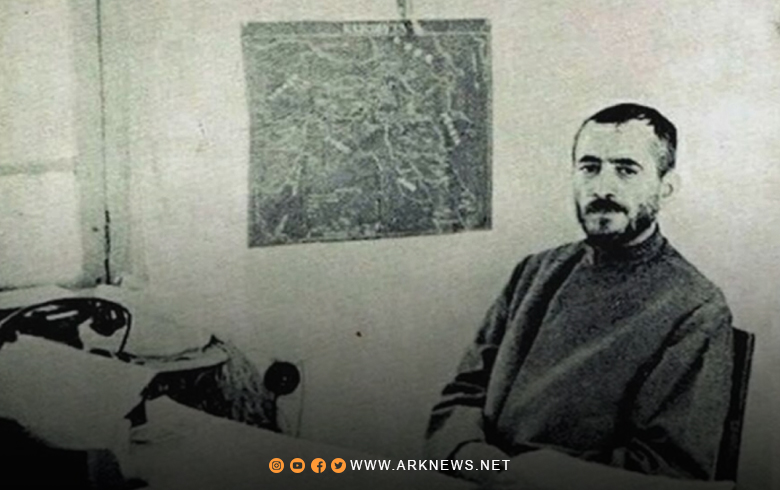
ARK News.. In the pages of modern Kurdish history, a number of names stand out for having carved their path through sacrifice and struggle. At the forefront of these figures stands Mullah Mustafa Barzani, the leader and spiritual father of the Kurdish liberation movement. His journey, spanning decades, was not merely the life of a political and military leader, but a living embodiment of the suffering and aspirations of an entire people striving for freedom amid complex geopolitical challenges.
Mullah Mustafa Barzani was born on March 14, 1903, in the village of Barzan, a date that marked the birth of a symbol who would carry the cause of his people for generations. His childhood was far from ordinary; in 1906, at only three years old, he and his mother were imprisoned, exposing him to injustice at a very early age.
As he grew older, his national and political awareness began to take shape. In 1919, he participated in the uprising led by Sheikh Mahmoud Al-Hafid against British forces. His efforts were not limited to Kurdish struggle alone; between 1920 and 1921, he also helped protect and assist Armenian families fleeing massacres, helping them reach safety in Syria.
The 1930s and 1940s witnessed harsh chapters of military confrontation. In 1930, Barzani supported the Mount Ararat Rebellion, and in late 1931 and early 1932, he led the Barzan uprising, during which his forces fought intense battles against the Iraqi army, inflicting significant losses.
Despite being exiled in the late 1930s to cities in central and southern Iraq, including Baghdad, Hillah, and Sulaymaniyah, Barzani broke free from exile in 1943 and returned to his homeland to lead a new uprising that shook the Iraqi government.
A historic turning point came in 1946, when Barzani founded the Kurdistan Democratic Party on August 16, 1946. During the same period, he moved with his Peshmerga fighters to support the Republic of Mahabad in Iran, where he was granted the rank of general and commanded the republic’s army.
After the fall of the Mahabad Republic, Barzani led one of the most remarkable military epics in 1947, guiding more than 500 Peshmerga fighters on a historic march that lasted several weeks. Crossing mountains and confronting multiple armies, they eventually crossed the Aras River and sought refuge in the Soviet Union, where they remained for nearly 12 years.
Following the 14 July Revolution in Iraq, Barzani returned home in 1958 to a massive popular and official reception. However, successive Iraqi governments soon reneged on Kurdish rights, prompting him to launch the September Revolution on September 11, 1961.
The resilience of this revolution forced the Iraqi government to negotiate, culminating in the 11 March 1970 Autonomy Agreement, which for the first time recognized the national rights and autonomy of the Kurdish people.
Peace did not last long. In 1974, war resumed after Baghdad retreated from its commitments. The Kurdish movement suffered a severe setback in 1975 following the Algiers Agreement between Iraq and Iran. Despite the setback, the struggle continued through what became known as the Gulan Revolution.
On March 1, 1979, at the age of 76, Mullah Mustafa Barzani passed away in a hospital in the United States after a battle with illness, leaving behind a legacy of struggle that remains deeply engraved in Kurdish history.
His body was temporarily buried in Oshnavieh in 1979. Years later, on October 6, 1993, amid a massive public reception attended by hundreds of thousands, his remains—along with those of his son Idris Barzani—were returned to Barzan, where he was finally laid to rest in the land of Kurdistan.
Mullah Mustafa Barzani remains alive in the memory of his people—a symbol of resilience and a leader whose legacy will forever endure in the pages of history.
165