Russia and China’s Arbitrary Veto Use 16 Times Contributed to Killing Nearly a Quarter of a Million Syrians, the Arrest of Nearly 150,000 Others, and the Spread of Impunity
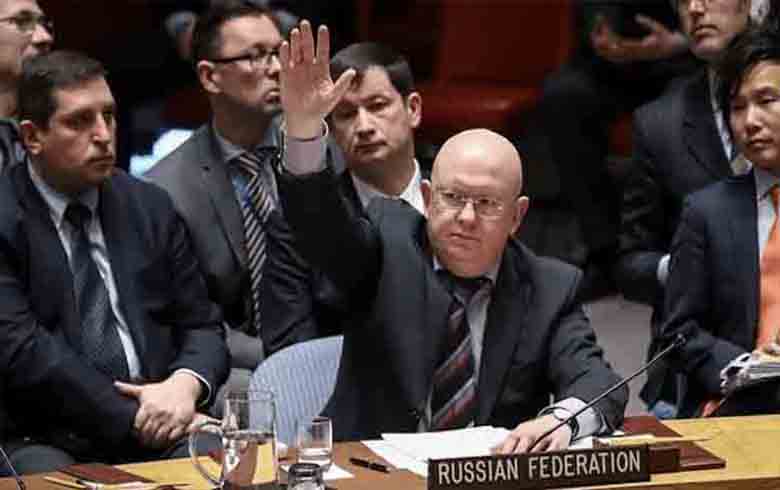
ARK News.. The Syrian Network for Human Rights (SNHR) reveals that Russia and China’s 16 arbitrary uses of veto on Syria has contributed to the deaths of nearly a quarter of a million Syrians, the arrest of nearly 150,000 others, and the spread of impunity, also noting that the timeline of the vetoes shows the extent of the UN Security Council’s (UNSC) terrible failure to protect civilians and establish peace and security in Syria.
The report stresses that the Syrian regime which has consistently disregarded all of the resolutions issued by the Security Council, starting with Resolution 2042 and Resolution 2043 related to Kofi Annan’s plan, continuing through Resolution No. 2139 to stop indiscriminate attacks, including barrel bombs, and end enforced disappearance, as well as following the same pattern with resolutions related to the prohibition of the use of chemical weapons, namely 2118, 2209, and 2235, all of which the Syrian regime has violated hundreds of times. Despite the regime’s flagrant contempt for all UN resolutions, the Security Council has taken no action and has failed to protect peace and security in Syria, from which 13 million Syrian citizens have been displaced to date, and more than 100,000 have been forcibly disappeared.
The report states that the failure to protect the rights of millions of victims and the complete impunity that the Syrian regime enjoys due to Russian and Chinese support have caused and bolstered the spread and promotion of terrorist and other extremist ideologies, for which oppression, injustice and instability are fuel, in Syria and internationally.
The report outlines the timeline of Russia’s and China’s use of their veto power in favor of their ally the Syrian regime, linking each use of this veto with the corresponding increasing death toll of civilian victims killed by the Syrian regime and Russian forces following the date of the veto. The report also attempts to show the scale of the escalation of the level of killing, in the context of Russia’s and China’s continuous assurance of full impunity for the Syrian regime from any form of punishment.
The report also outlines a cumulative chart showing the reality of the veto use by Russia and China in the UN Security Council, and the civilian death toll of those killed by Syrian-Russian alliance forces in the periods between each time Russia and China used the veto power from March 2011 up to July 10, 2020.
The report emphasizes the SNHR’s belief that the most egregious use of veto power was its application in order to protect the Syrian regime over the issue of its use of chemical weapons, which was, as the report reveals, conclusive evidence of both superpowers’ support for the Syrian regime’s use of weapons of mass destruction, noting that this means, in practice, a far wider and complete undermining of the mission for which the Security Council claims to have been established, which is to protect international peace and security.
As the report reveals, the Syrian regime used chemical weapons 21 times since the first veto use in relation to chemical weapons issue on February 28, 2017, until the last documented chemical weapons use in al Kbaina village on May 19, 2019. The report also outlines a timeline showing the distribution of these 21 chemical weapons attacks carried out by the Syrian regime amid six Russian vetoes against UN draft resolutions regarding CW use in Syria.
The report notes that the Russia and China have used their veto power three times to prevent the delivery of UN aid provided for more than four million internally displaced people, adding that the Security Council has subjected the process of delivering cross-border aid to its hegemony, even though this assistance is humanitarian, neutral, and provided by the OCHA, and is not considered interference in the conflict, being provided to people who have been forcibly displaced.
As the report notes, the Syrian regime has committed heinous crimes and violations against Syrian civilians on a daily basis for nine years to date. It has also consistently failed to comply with any of the demands of the International Commission of Inquiry on the Syrian Arab Republic, or those of the High Commission for Human Rights, or even Security Council resolutions. The Security Council, which is supposed to take collective measures and action under Article 41 and 42 of the Charter of the United Nations, has also failed because of the immunity granted by Russia to the Syrian regime, with Russia routinely using its veto to protect the Syrian regime, which has not only failed to abide by its responsibility to protect civilians, but has committed and continues to commit the most egregious violations against them, reaching the level of crimes against humanity.
Furthermore, the report states, the type of “conscience-shocking situations” which the UN is required to take action to prevent are exactly what have continued to happen in Syria on a staggering scale, not only in the form of one massacre or one violation but in industrial-scale, continuous killings and torture, sexual violence, enforced disappearances, the use of chemical weapons and barrel bombs, and besieging civilians. In this context, the report cites a report issued in December 2001 by the International Commission on Intervention and State Sovereignty, which stressed that: “The Security Council should take into account in all its deliberations that, if it fails to discharge its responsibility to protect in conscience-shocking situations crying out for action, concerned states may not rule out other means to meet the gravity and urgency of that situation. ”
The report calls on the UN Security Council to initiate fundamental reforms, particularly in the area of the use of the veto in accordance with international law and human rights, and to establish strict limitations and standards for the use of the veto, to place the public interest, especially that of victims and affected countries and the attainment of just security and peace before the economic and political gains and interests of any permanent member state, and to create a mechanism to monitor the extent to which Security Council resolutions are compatible with the Charter of the United Nations, with international law, and with the jurisdiction of the Security Council, and to monitor compliance with established standards for the use of the veto.
608