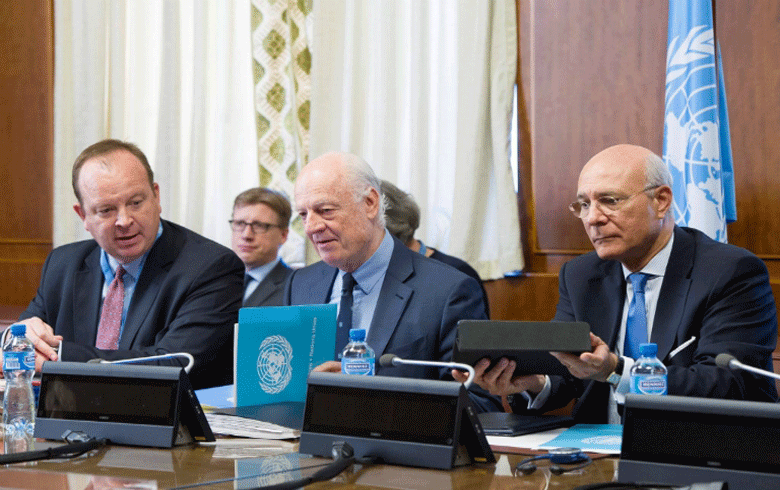
A group of civil society activists from the Eastern Province conveys a message to the special international envoy to Syria
Office of the UN Special Envoy to Syria
Partners; Swisspeace and NOREF
Civil Society Support Team
ARK News: We are a group of civil society activists and employees of civil organizations from
the Eastern Province of Syria. This is the first time that we have been given this
opportunity to convey our message to you about the suffering of our people and the
deteriorating humanitarian situation in Syria as a result of the war that has been going
on for eight years. We will try to provide you with a clear image of this area and the
humanitarian situation there, since the beginning of the Syrian crisis and its
aggravation, which surpassed every perception. The Eastern Region includes
Governorates of (Raqqa - Deir Al-Zour - Hasaka).
In terms of location and area: This area is located in the east-north of Syria and is
called the largest part of the island between the Euphrates and Tigris rivers, an area
of 76000 square kilometers, or more than a third of the area of Syria.
In terms of economic importance: This region is the mainstay of the Syrian economy,
as it produces all Syrian oil, more than 53% of natural gas, 75% of wheat, cotton and
other agricultural crops and 68% of Syrian water resources are in this region. For the
passage of the Euphrates River and its codification, this has made it the nerve of the
Syrian economy and the food security of Syria and the pillar of stability on the entire
Syrian territory.
Demographic and Social Reality: The population of the Eastern Region (Al-Raqqa -
Deir Al-Zour Al-Hasakah) has exceeded 4 million according to the last census before
2011. The population of this region enjoys common coexistence and a spirit of love,
understanding and cooperation among all the components where the ethnic and
religious diversity of this region and the cultural mix is there.
Components in this region can be identified as follows:
1-Deir al-Zour Governorate, a population of Sunni Arabs.
2-Raqqa Governorate, the majority of the Sunni Arabs, with the exception of a
minority of Kurds and Turkmen, are estimated at about 3% of the population.
3-Al-Hasakah Governorate is the most diverse population in the region, which
consists mainly of the following:
-Sunni Arabs constitute about 65% of the population of the province
-Kurds: They make up about 27% of the population of the province
- Christians of different ethnicities and sects (Assyrians, Armenians) make up 8%.
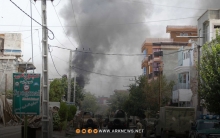
In this region, there were battles between units of the Syrian army and the opposition
forces, which were followed by a bombardment of flight, that left thousands of
victims and a lot of destruction, accompanied by a large movement of displacements
in various areas, mainly affected the areas inhabited by Arabs, internal displacement
and resort to Turkey. There is also a displacement of the Kurdish component
towards Turkey and northern Iraq, but this was mainly due to the practices of the
militias of the Democratic Union Party (PYD), political arrests, forced recruitment,
and so on.
After ISIS took over in March of 2014, the tragedy in these areas worsened and the
humanitarian situation deteriorated due to the terrible violations committed under this
the group, especially against civilians, activists, journalists, and humanitarian staff, which
prevented them from entering these areas and negatively affected the services and
civil institutions.
But the great humanitarian disaster that occurred in these areas was with the start of
the International Alliance to wage war on ISIS, with the support of the Kurdish
People's Protection units.
In addition, most of the areas belonging to Raqqa and Deir Al-Zour were subjected
to heavy bombardments of rockets and mortars without neutralizing civilians and
protecting them, which left huge destruction to the housing, infrastructure, schools
and hospitals. A report by the United Nations said that the destruction in the city of
Raqqa alone included more than 80% of the number of buildings inside the town.
The war in this region has left tens of thousands of victims and more than the
the number of wounded. The thousands of those still missing are still in the rubble, as are
the large numbers of displaced people, including entire cities and villages. The
the number of displaced persons has been huge. Basic humanitarian and medical services
for those fleeing from hell to the open, as well as the establishment of adequate
shelter camps, although they lack the lowest standards in place, but are more like
large detention camps where displaced persons are subjected to extortion and
material exploitation Humiliation and humiliation by the militia, which is overseen
by the militias, until they were called by activists in the death camps.
After defeating the entire region under the control of SDF forces, with the exception
of some towns and sites in Deir Al-Zour and Hasakah, which is controlled by the
Syrian army and its associated militias, these areas were subjected to new violations
of massacres against civilians, burning villages and bulldozing and looting of public
and private property on charges of supporting them. As an incubator abuses against
civilians, especially women in these areas, were very severe, from gender-based
violence to forced conscription of young girls, as well as forced conscription, imposed
by forceful forces on young people. The children of the region, including many
documented cases in which the recruitment of children, in addition to changing the
curricula of the primary and intermediate stages, and the imposition of curriculum
approaches adopting revolutionary violence, in addition to the systematic
demographic change in some areas exacerbated the deteriorating humanitarian
situation there
The de facto militias in these areas have also arrested thousands of civilians and
imprisoned them without an independent judiciary and professional courts. Many
cases of torture have been documented in prisons under torture, in addition to the
absence of hundreds,
In the area of Mayadeen and Albu Kamal in the governorate of Deir Al-Zour, the
militias supported and calculated on the regional sides are deliberately targeting the
demographic change in the region and are building places of worship that do not
match the doctrine, ideology, and concepts of the indigenous people.
These happened before the eyes of the world in defiance of all international
conventions and laws and a flagrant violation of the principles of human rights by all
the conflicting parties in the region and the international forces intervening.
Independent International Rights Reports on the Eastern Region:
1. On June 19, 2014, Human Rights Watch issued a report titled "Under
Kurdish Rule".(Violations in areas under the Kurdish Democratic Union
Party). The report spoke about arbitrary arrests, torture that sometimes
ends in death, the recruitment of children into their forces and battles, and
the massacre of Kurdish civilians against Amuda.
2. On 5 July 2014, the Swiss Humanitarian Appeal announced that it had
obtained the commitment of the People's Protection Forces, the Women's
Protection Forces (not to recruit children, and they had promised to
demobilize 149 children.
3. On June 1, 2015, the British newspaper “The Times” published a report on
ethnic cleansing campaigns by Kurdish protection forces against Syrian
Arabs in areas under their control.
4. On September 7, 2015, Amnesty International issued a press release on
human rights violations by the Democratic Unionist Party and its armed
militia against their opponents and that they use the charge of terrorism for
their violators to legitimize arbitrary arrests.
5. Amnesty International issued an alarming report on Tuesday (13 October
2015) entitled "We had no other place to go": forced displacement and
house demolitions in northern Syria. The report accused the militias of
protecting And forced the residents to leave under the threat of death. The
report indicates that this happened after the region moved from the control
of state organization (Da'esh) to the control of units Protect the Kurdish
people between 2014 and 2015.
Preliminary results of these humanitarian conditions in the eastern regions:
-Destroyed cities, towns, and villages, 1.5 million displaced persons (between
displaced and refugees).
-Internally displaced people live in informal camps that lack the minimum
standard of living and standards.
-Destroyed schools and hospitals and a complete collapse in the education and
health sectors.
-Most of the displaced and the displaced cannot return to their homes even if they
remain from their homes, which is suitable for housing because of fear of
retaliation and forced recruitment.
However, there is no real initiative or international will to resolve the tragedy and
end the tragedy of the Syrian people in the near future. Accordingly, through this
letter, we emphasize the following recommendations, without which the Syrian
crisis can’t be solved:
1-Ceasefire and exit of all international forces and extraneous militias.
2-Continuing in the political solution and supporting the negotiating process under
the auspices of the United Nations based on Security Council resolution 2254 and
it is obligations.
3-Immediately and promptly release all detainees and disclose the fate of those
missing and forcibly disappeared.
4-Forming an independent international team to investigate violations of
international human rights law on Syrian soil and to hold those involved
accountable because justice and the restoration of rights to their owners is a sacred
humanitarian principle before it is the basis for social reconciliation and
restoration of security and stability.
5-Increasing the support and humanitarian assistance to the IDP camps in the
Eastern Province, fully supervise them and not allow the militias to attack them
6-Voluntary and safe return of all refugees and displaced persons to the areas from
which they were first displaced.
7-Action to remove mines from areas of conflict, which today are very dangerous
there.
8-Increasing the representation of the Eastern Region within the civil society
groups in all United Nations forums concerned with Syrian affairs
We hope that this letter will be adopted as one of the documents of the Office of
the Special Envoy to Syria.
In conclusion, we thank the UN team and the Office of the Special Envoy to Syria
for giving us the opportunity to communicate the voice and suffering of our
people in the eastern provinces to your international forum.
with all due respect
A group of civil society activists from the Eastern Province
18/02/2019
676