Syria Is Among the World’s Worst Countries for the Number of Mines Planted Since 2011, Despite Prohibition of Their Use in International Law
Mines Have Killed at Least 2,601 Civilians in Syria Since 2011, Including 598 Children and 267 Women, with Women and Children Accounting for 33% of All Victims
ARK News… The Syrian Network for Human Rights (SNHR) reveals in its report released on Thursday that Syria is among the world’s worst countries for the number of mines planted since 2011, despite the prohibition of their use in international law, noting that mines have killed at least 2,601 civilians in Syria since 2011, including 598 children and 267 women, meaning that 33% of the victims were women and children
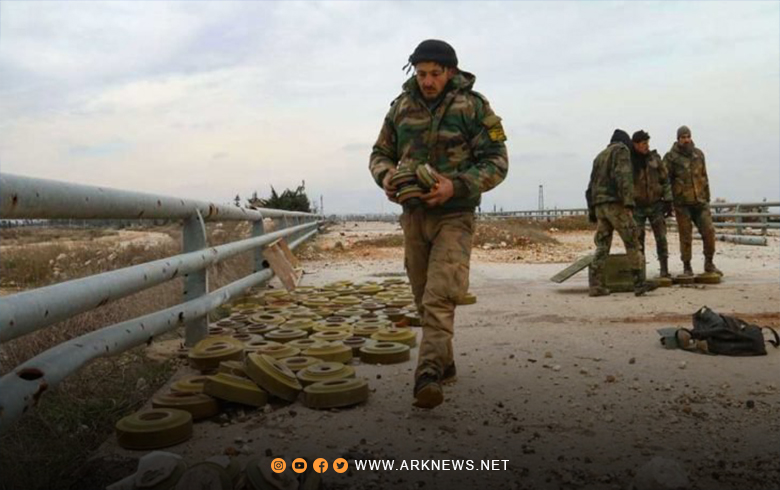
The report deals with anti-personnel and anti-vehicle landmines, which are weapons designed to be placed under or above the ground, then to explode because of the proximity of or contact with a person or vehicle. The report further explains that there are distinctive difficulties and challenges facing the SNHR’s staff which prevent us from being able to conclusively assign responsibility for killings caused by landmines to a specific party of the conflict, with the most prominent of these being, as the report reveals:
• Most of the parties to the conflict are using this type of weapon.
• There have been multiple changes of control by parties to the conflict and forces over the areas where minefields exist, with none of the parties to the conflict and the controlling forces in Syria publishing maps revealing the locations where they planted landmines.
As the report reveals, the parties to the conflict (except for the US-led coalition forces and the Russian forces) have used mines for almost 10 years, despite the international ban on their use. The report attributes that to the Syrian regime’s possessing tens of thousands of mines, in addition to the ease and low cost of their manufacture, which have enabled other parties to the conflict to use them extensively, showing absolute indifference to disclosing their locations or clearing them.
The report documents the deaths of at least 2,601 civilians, including 598 children and 267 women (adult female), killed since March 2011 due to hundreds of mine explosions in various Syrian governorates; among those killed, there were eight medical personnel, sic Civil Defense personnel, and nine media workers.
As the report reveals, most of the landmine victims were documented in Aleppo and Raqqa governorates, with the death toll from landmine explosions in both governorates comprising approximately 51% of the total death toll, meaning that half of the recorded fatalities from landmines in Syria have been killed in these two governorates, followed by Deir Ez-Zour governorate with approximately 16% of the total, Daraa with approximately 9%, then Hama with 7%. The report attributes the varying percentages between different areas to many factors, the most prominent of which is the changing nature of control over the areas by the parties to the conflict, and the multiplicity of the parties that controlled the same governorate, with Aleppo governorate being one of the governorates which saw the highest rates of shifting control among the various parties.
The report further notes that international humanitarian law has, since its inception, significantly restricted the use of landmines; the Protocol II of the Convention on Certain Conventional Weapons also defined the rules of landmines’ use but has not prohibited them. The International Committee of the Red Cross (ICRC) and a number of NGOs have made great efforts to work towards an absolute ban on the use of mines, with these efforts culminating in the Convention on the Prohibition of the Use, Stockpiling, Production and Transfer of Anti-Personnel Mines and on Their Destruction (Ottawa Convention), which entered into force in March 1999, with 164 states are currently party to the convention, constituting the vast majority of the world states, making the international mine ban a binding international norm for all states and parties to the conflict, whether signatory or not.
The report further emphasizes that the use of mines violates the principle of distinction between civilian and military objects, and the principles of precautions and proportionality in attacks, with the failure to respect these provisions constituting a war crime under international humanitarian law and under the statute of the International Criminal Court.
As the report reveals, none of the perpetrator parties which have used mines in Syria have provided maps revealing where the mines were planted, nor have they worked seriously to remove them, most particularly the Syrian regime, which has not carried out any deliberate mine clearance operations despite recapturing large areas.
The report calls on all parties to the conflict to respect the rules of international humanitarian law and international human rights law, to stop planting mines targeting civilians and civilian objects, and to initiate mine clearance operations in areas under their control, especially in places where they planted mines and which are under their control or over which they have regained control and where they are aware of the mines’ locations. The report also calls on all the parties to the conflict to provide detailed maps of the locations where they planted mines, especially civilian sites or near residential communities.
The report recommends that the UN Security Council and International Community should increase logistical assistance to local organizations and local police working in the field of detecting and dismantling mines, to allocate a significant amount of money for clearing mines left over by the Syrian conflict from the United Nations Mine Action Service, particularly in areas prepared to carry out this task with transparency and integrity, to begin to compensate victims and their families, to focus on the psychological treatment process for survivors, and to support humanitarian organizations working in the field of psychological care.
Source: SNHR
540